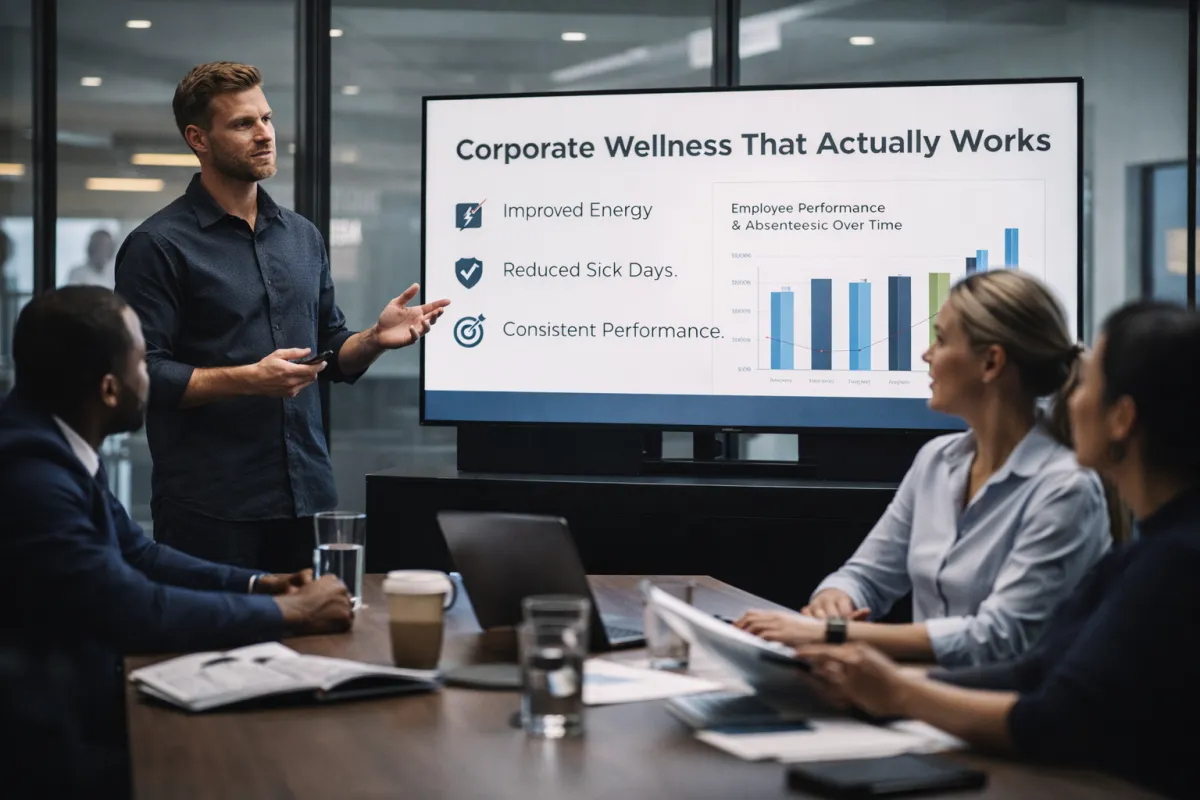
Corporate Wellness That Actually Improves Performance | Higher Standards
Corporate wellness programs were designed with good intentions.
Most fail in execution.
Gym discounts go unused.
Step challenges fade after week two.
Wellness emails get ignored.
The result? Companies spend money on “wellness” while productivity, energy, and retention remain unchanged.
The problem isn’t that wellness doesn’t work.
It’s that most programs are incentives without infrastructure.
The Real Cost of Poor Health at Work
Employee health is no longer a personal issue—it’s an operational one.
Poor physical conditioning contributes directly to:
Lower energy and focus
Increased absenteeism
Higher stress and burnout
Reduced consistency in performance
These issues don’t show up as line items on a P&L, but they absolutely affect outcomes.
Wellness programs fail when they’re treated as culture initiatives instead of performance systems.
Why Most Corporate Wellness Programs Don’t Stick
Traditional programs focus on awareness, not execution.
Common issues include:
No structure or progression
No accountability
No integration into daily routines
No measurable performance outcomes
Motivation-based initiatives create short-term engagement, not lasting behavior change.
And without behavior change, nothing improves.
Wellness Works When It’s a System
Sustainable corporate wellness follows the same principles as high-performance training:
Structure beats motivation
Consistency beats intensity
Systems beat perks
Employees don’t need more encouragement.
They need fewer decisions.
What a Modern Corporate Wellness System Looks Like
Effective corporate wellness aligns health with performance—not as an add-on, but as infrastructure.
1. Structured Movement, Not Random Activity
Employees don’t need extreme workouts.
They need repeatable, scalable training options that fit real schedules.
Short, structured programs reduce injury risk, improve energy, and support long-term adherence.
2. Practical Nutrition Guidance (Not Diet Culture)
Nutrition at work isn’t about weight loss challenges.
It’s about:
Energy stability
Focus throughout the day
Recovery from stress
Simple, system-based nutrition guidance outperforms restrictive or trend-driven approaches every time.
3. Stress and Recovery as Performance Variables
Burnout isn’t a mindset problem—it’s a recovery problem.
Wellness systems that acknowledge:
Sleep
Stress load
Recovery capacity
produce better decision-making and more consistent output across teams.
The Business Case for Structured Wellness
When wellness is implemented as a system, companies see:
Higher employee engagement
Reduced sick days
Improved morale and retention
More consistent performance
The ROI isn’t just health-related—it’s operational.
Healthy teams are more reliable teams.
Why One-Size-Fits-All Doesn’t Work at Work Either
Just like fitness, employees have different needs:
Different schedules
Different stress loads
Different physical baselines
The most effective corporate wellness programs offer guided structure with flexibility, not rigid mandates.
Wellness Should Support the Business — Not Distract From It
The goal of corporate wellness isn’t to turn employees into athletes.
It’s to:
Improve daily energy
Reduce friction in performance
Support consistency under pressure
When wellness aligns with how people actually work, adoption follows naturally.
A Higher Standard for Workplace Wellness
At Higher Standards Lifestyle, we believe corporate wellness should function like any other high-performing system:
Designed.
Structured.
Measured.
Sustainable.
No fluff. No guilt-based initiatives. No wasted spend.
Just systems that support people so they can perform at their best—consistently.
Final Thought
You don’t need more wellness perks.
You need better wellness design.
When health supports performance instead of competing with it, everyone wins.
